
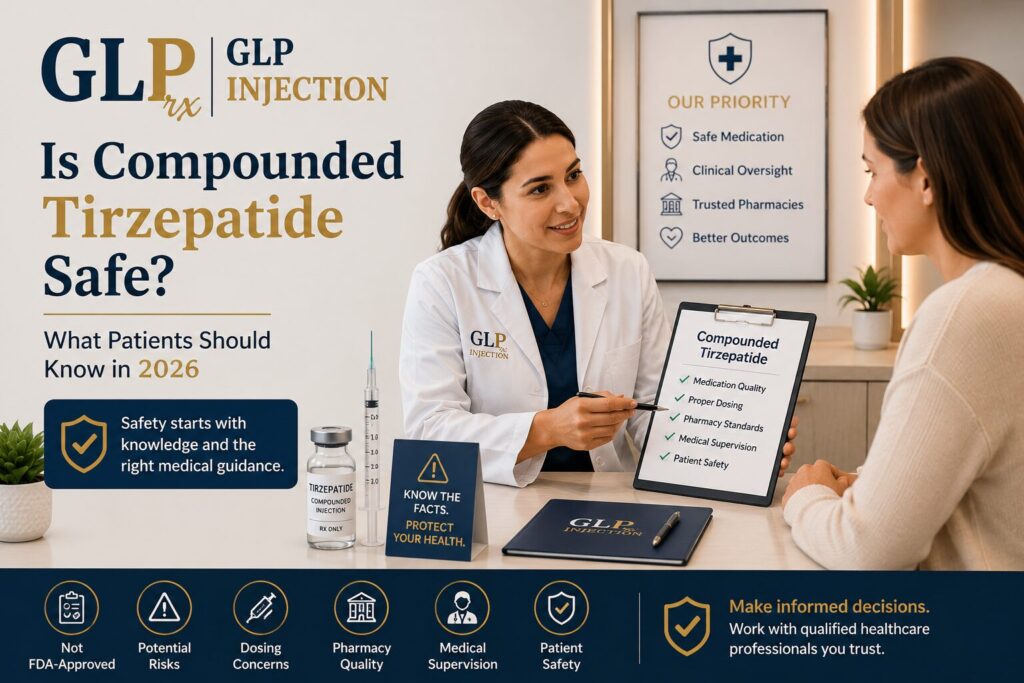
If you are considering compounded tirzepatide for weight loss, it is reasonable to ask: Is compounded tirzepatide safe?
The short answer is: compounded tirzepatide is not the same as FDA-approved tirzepatide, and it does not undergo the FDA’s premarket review for safety, effectiveness, and quality. That does not mean every compounded product is unsafe, but it does mean patients need to understand the additional risks, sourcing requirements, dosing issues, and legal considerations before using one.
The FDA has specifically reported adverse events associated with compounded tirzepatide and has warned about problems involving dosing, product quality, fraudulent labeling, and improper storage.
For patients considering treatment through GLP Injection, the safest approach is to discuss your medical history, treatment goals, medication options, and appropriate dosing with a qualified healthcare professional.
Key takeaway: FDA-approved tirzepatide has undergone FDA review for its intended uses. Compounded tirzepatide has not. If a compounded medication is being considered, patients should understand why it is appropriate for their individual situation and verify the pharmacy and prescribing process.
What Is Compounded Tirzepatide?
Compounded tirzepatide is a medication prepared by a compounding pharmacy rather than manufactured and approved as a finished drug product by the FDA.
Compounding can serve legitimate medical purposes when an FDA-approved medication does not meet a patient’s specific needs. However, compounded drugs are not FDA-approved, and the FDA does not conduct the same premarket review of their safety, effectiveness, or quality that it conducts for approved medications.
This distinction is important:
FDA-approved medication:
Has undergone FDA review of safety, effectiveness, quality, manufacturing, and labeling for its approved use.
Compounded medication:
Is prepared to meet particular patient needs under applicable compounding laws and does not receive the same FDA premarket approval process.
Therefore, compounded tirzepatide should not be marketed as an FDA-approved equivalent or generic version of Zepbound.
Is Compounded Tirzepatide FDA Approved?
No. Compounded tirzepatide is not FDA-approved.
Tirzepatide itself is an FDA-approved active ingredient in products such as Zepbound, which is approved for chronic weight management in appropriate adults, and Mounjaro, which is approved for certain adults with type 2 diabetes.
However, the approval of those branded products does not mean that a compounded tirzepatide product has received FDA approval.
The FDA states clearly that compounded drugs do not undergo its premarket review for safety, effectiveness, and quality.
Is Compounded Tirzepatide Safe for Weight Loss?
There is no simple yes-or-no answer.
A compounded medication may be appropriate in certain circumstances, but its safety cannot be assumed simply because it contains tirzepatide.
The FDA has reported adverse events associated with compounded tirzepatide and notes that adverse-event reporting from some state-licensed pharmacies may be incomplete. As of May 31, 2026, FDA had received more than 730 reports of adverse events associated with compounded tirzepatide. The agency also notes that it is not always possible to determine whether the compounded medication directly caused an individual adverse event.
This does not mean that 730 people were proven to have been harmed by compounded tirzepatide. It means the FDA received those reports, and causation cannot necessarily be established from the reports alone.
That distinction matters when evaluating online claims about compounded GLP-1 safety.
Why Can Compounded Tirzepatide Carry Additional Risks?
Several factors can affect the safety of a compounded injectable medication.
-
No FDA Premarket Approval
The FDA does not review compounded drugs for safety, effectiveness, and quality before they are marketed in the same way it reviews FDA-approved medications.
-
Dosing Errors
Compounded injectable medications may be supplied in different concentrations and formats.
The FDA has received reports involving dosing errors with compounded GLP-1 medications, including cases associated with incorrect measurement and administration. It has also received reports involving compounded semaglutide or tirzepatide prescribed at doses or titration schedules outside the FDA-approved labeling.
This is why patients should never guess how much compounded medication to draw into a syringe.
-
Product Quality
The quality of a compounded medication depends on the compounder’s processes, ingredients, equipment, controls, storage, and compliance with applicable requirements.
In February 2026, the FDA reported a case involving a pharmacy whose compounded tirzepatide products were found to have potency below their labeled strength.
This illustrates why pharmacy selection matters.
-
Storage and Shipping
Injectable GLP-1 medications may require specific storage conditions.
The FDA has received complaints about compounded GLP-1 products arriving warm or with inadequate refrigeration during shipping. The agency advises patients not to use an injectable GLP-1 product that arrives warm or without adequate refrigeration, because improper storage can affect product quality.
-
Fraudulent Products
Another concern is purchasing medication from an unknown online source.
The FDA has identified fraudulent compounded semaglutide and tirzepatide products with false labeling. In some cases, pharmacies listed on labels did not actually compound the products.
That is very different from receiving a prescription from a legitimate healthcare provider and having it filled by a properly licensed pharmacy.
What Are the Side Effects of Tirzepatide?
Tirzepatide can cause side effects whether it is used as an FDA-approved product or a compounded preparation containing tirzepatide.
Common gastrointestinal effects can include:
- Nausea
- Diarrhea
- Vomiting
- Constipation
- Abdominal discomfort or pain
- Decreased appetite
The FDA has reported gastrointestinal adverse events among people using compounded semaglutide and tirzepatide, including nausea, vomiting, diarrhea, abdominal pain, and constipation. Some reported events were serious.
Compounded products can introduce additional concerns because concentration, preparation, labeling, and administration instructions may differ.
If you experience severe or persistent symptoms after taking tirzepatide, contact your healthcare provider promptly.
Why Is Tirzepatide Dosing So Important?
Tirzepatide treatment typically involves gradual dose adjustment rather than immediately starting at a higher dose.
The purpose of titration is to help the body adjust to treatment and manage tolerability.
With compounded tirzepatide, patients may encounter different vial concentrations or measurement instructions. This can make it easier to confuse milligrams (mg), milliliters (mL), and syringe units.
For example, two vials can contain different concentrations even when the medication name is the same.
Never calculate or change your dose yourself based on an online chart.
Your prescribing clinician should provide specific instructions for:
- The prescribed dose
- How often to take it
- How much liquid to administer
- How to measure the dose
- When to increase or maintain the dose
- What to do if you miss a dose
The FDA specifically recommends that healthcare providers carefully determine dosing and titration and that patients discuss how to measure and administer the intended dose.
Is Compounded Tirzepatide the Same as Zepbound?
No.
Zepbound is an FDA-approved prescription medication containing tirzepatide.
A compounded tirzepatide preparation is not an FDA-approved generic version of Zepbound.
The FDA has specifically warned telehealth companies against marketing compounded GLP-1 products in ways that imply they are the same as FDA-approved medications.
This distinction is especially important when comparing prices.
A lower advertised price does not automatically mean you are receiving the same product, regulatory review, manufacturing process, labeling, or quality assurance associated with an FDA-approved medication.
Why Is Compounded Tirzepatide Still Available?
Compounding is allowed under specific federal and state requirements in certain circumstances.
The FDA explains that compounded drugs may be appropriate when a patient’s medical needs cannot be met by an FDA-approved medication or when an FDA-approved drug is not commercially available. However, compounded drugs carry additional risks because they do not undergo FDA premarket review.
The legal environment surrounding compounded tirzepatide has also changed as the national supply situation has changed.
The FDA determined that the tirzepatide injection shortage was resolved in December 2024.
In April 2026, the FDA further clarified its policies for compounders as GLP-1 supply stabilized. Under Section 503A, for example, compounding generally must be based on an individual patient’s prescription and must satisfy applicable restrictions concerning copies of commercially available drugs.
The FDA also proposed in April 2026 to exclude tirzepatide from the 503B bulk-drug substances list, stating that it had not identified a clinical need for outsourcing facilities to compound tirzepatide from bulk substance under that pathway.
Because compounding rules can change and depend on the specific pharmacy, prescription, and circumstances, patients should not assume that every compounded tirzepatide product is legally available simply because it is advertised online.
How Can You Tell If a Compounded Tirzepatide Pharmacy Is Legitimate?
Before obtaining compounded tirzepatide, ask these questions.
Is the pharmacy licensed?
The FDA advises consumers to purchase medications from state-licensed pharmacies and be cautious with online sellers.
Is a healthcare professional prescribing the medication?
A legitimate treatment process should involve an appropriate medical evaluation rather than simply selling medication without clinical assessment.
Can the pharmacy be identified?
You should be able to determine:
- The pharmacy’s legal name
- Its location
- Its state license
- Who compounds the medication
- How the medication is labeled
- How to contact the pharmacy
Is the medication properly labeled?
Avoid products with vague or suspicious labeling.
The FDA has identified fraudulent compounded GLP-1 products carrying false pharmacy information.
Are storage instructions clear?
Ask how the medication should be stored and what to do if it arrives warm.
What Should You Ask Before Starting Compounded Tirzepatide?
A short conversation with your healthcare provider can prevent many problems.
Ask:
- Why is compounded tirzepatide appropriate for me?
- Is an FDA-approved tirzepatide product available to me?
- Which pharmacy will prepare and dispense the medication?
- Is the pharmacy properly licensed?
- What concentration is in my vial?
- What dose should I take?
- How many mL or syringe units equal my prescribed dose?
- How should I store the medication?
- What should I do if the medication arrives warm?
- When should my dose be adjusted?
- What side effects should I report?
- What happens if I miss a dose?
A transparent provider should be able to answer these questions clearly.
Compounded Tirzepatide vs. FDA-Approved Tirzepatide
| Factor | Compounded Tirzepatide | FDA-Approved Tirzepatide |
| FDA-approved finished product | No | Yes |
| FDA premarket review | No | Yes |
| Prescription required | Generally yes under applicable law | Yes |
| Individualized compounding possible | In qualifying circumstances | No |
| Standardized FDA-approved labeling | No | Yes |
| Quality/safety review before marketing | Not the same FDA process | Yes |
| Dosing instructions | May vary by preparation | Standardized labeling |
| Pharmacy preparation | Compounding pharmacy | Approved manufacturer |
The comparison does not mean compounded medication is automatically dangerous. It means the regulatory pathway and level of FDA review are different.
Is Compounded Tirzepatide Cheaper?
It can be advertised at a lower price than branded treatment, but price should not be the only factor.
When comparing treatment costs, consider:
- Medication
- Medical consultation
- Follow-up visits
- Dose management
- Supplies
- Shipping
- Pharmacy
- Laboratory testing when clinically indicated
- Insurance coverage
- Whether the medication is FDA-approved
A very low price from an unknown online seller may not represent a safe or legitimate treatment option.
The cheapest GLP-1 medication is not necessarily the best value if its source, concentration, storage, or prescribing process is unclear.
Does GLP Injection Offer Tirzepatide Treatment?
GLP Injection provides physician-guided weight management programs that may include tirzepatide treatment after an appropriate medical evaluation.
The goal should be to determine whether tirzepatide is appropriate for the individual patient, rather than selecting a medication or dose solely because it is inexpensive.
If you are considering tirzepatide, discuss your medical history, current medications, weight-management goals, and potential risks with a qualified healthcare professional before treatment.
What Does the Research Say About Tirzepatide?
Tirzepatide has been extensively studied in clinical trials and is an FDA-approved medication for specific indications.
However, it is important to separate evidence for FDA-approved tirzepatide products from evidence for a particular compounded preparation.
Clinical trial results for Zepbound or other FDA-approved tirzepatide products should not automatically be interpreted as proof that every compounded tirzepatide formulation has the same safety, effectiveness, stability, or quality.
This is one of the most important points consumers should understand when researching compounded GLP-1 medications.
Frequently Asked Questions About Compounded Tirzepatide
Is compounded tirzepatide safe?
Compounded tirzepatide is not FDA-approved and does not undergo the FDA’s premarket review for safety, effectiveness, and quality. Some compounded products may be appropriate in specific circumstances, but patients should discuss the risks and benefits with a qualified healthcare provider and verify the pharmacy source.
Is compounded tirzepatide FDA approved?
No. Compounded tirzepatide is not FDA-approved. FDA-approved tirzepatide products such as Zepbound have undergone FDA review for their approved indications.
Is compounded tirzepatide the same as Zepbound?
No. Compounded tirzepatide should not be described as a generic version of Zepbound. Compounded drugs and FDA-approved drugs follow different regulatory pathways.
What are the risks of compounded tirzepatide?
Potential concerns include dosing errors, product quality problems, improper storage, inaccurate labeling, fraudulent products, and adverse effects. The FDA has received more than 730 reports associated with compounded tirzepatide as of May 31, 2026, although the agency notes that causation cannot always be determined.
Can compounded tirzepatide cause side effects?
Yes. Tirzepatide can cause gastrointestinal side effects such as nausea, vomiting, diarrhea, constipation, and abdominal discomfort. Incorrect dosing or administration can create additional risks.
How do I know if a compounded tirzepatide pharmacy is legitimate?
Use a properly licensed pharmacy and verify its identity and licensing information. Avoid websites that sell prescription medication without appropriate medical evaluation or that make claims that compounded medication is FDA-approved or identical to an approved product.
Can compounded tirzepatide be used for weight loss?
Tirzepatide is FDA-approved for chronic weight management in appropriate patients through Zepbound. Whether a compounded preparation can legally and medically be used for an individual patient depends on applicable compounding requirements and the patient’s specific medical circumstances.
Should I choose compounded or FDA-approved tirzepatide?
That decision should be made with your healthcare provider. An FDA-approved product has undergone FDA premarket review, while compounded tirzepatide has not. If an FDA-approved treatment is appropriate and available, your provider can help you weigh its benefits, risks, availability, and cost against any legitimate reason for considering a compounded medication.
The Bottom Line
Is compounded tirzepatide safe?
The most accurate answer is that compounded tirzepatide cannot be assumed to have the same safety, effectiveness, or quality assurance as an FDA-approved tirzepatide product.
Compounding can have a legitimate role in patient care, but it comes with a different regulatory framework. The FDA has identified concerns involving compounded GLP-1 products, including dosing errors, storage problems, fraudulent products, and quality issues.
If you are considering compounded tirzepatide, focus on more than the monthly price.
Choose a treatment process that provides:
- Appropriate medical evaluation
- Clear dosing instructions
- Responsible titration
- A legitimate, licensed pharmacy
- Proper medication storage and handling
- Ongoing clinical monitoring
- Transparent information about the medication you are receiving
GLP Injection can help patients understand their tirzepatide treatment options and determine whether a GLP-1 weight-management approach may be appropriate. Treatment decisions should always be made with a qualified healthcare professional based on your individual health needs.
Medical disclaimer: This article is for educational purposes only and is not a substitute for medical diagnosis, treatment, or individualized medical advice. Prescription medications should be used only under the direction of a qualified healthcare professional. FDA regulations and compounding policies can change, so patients should verify current requirements and medication availability before treatment.